





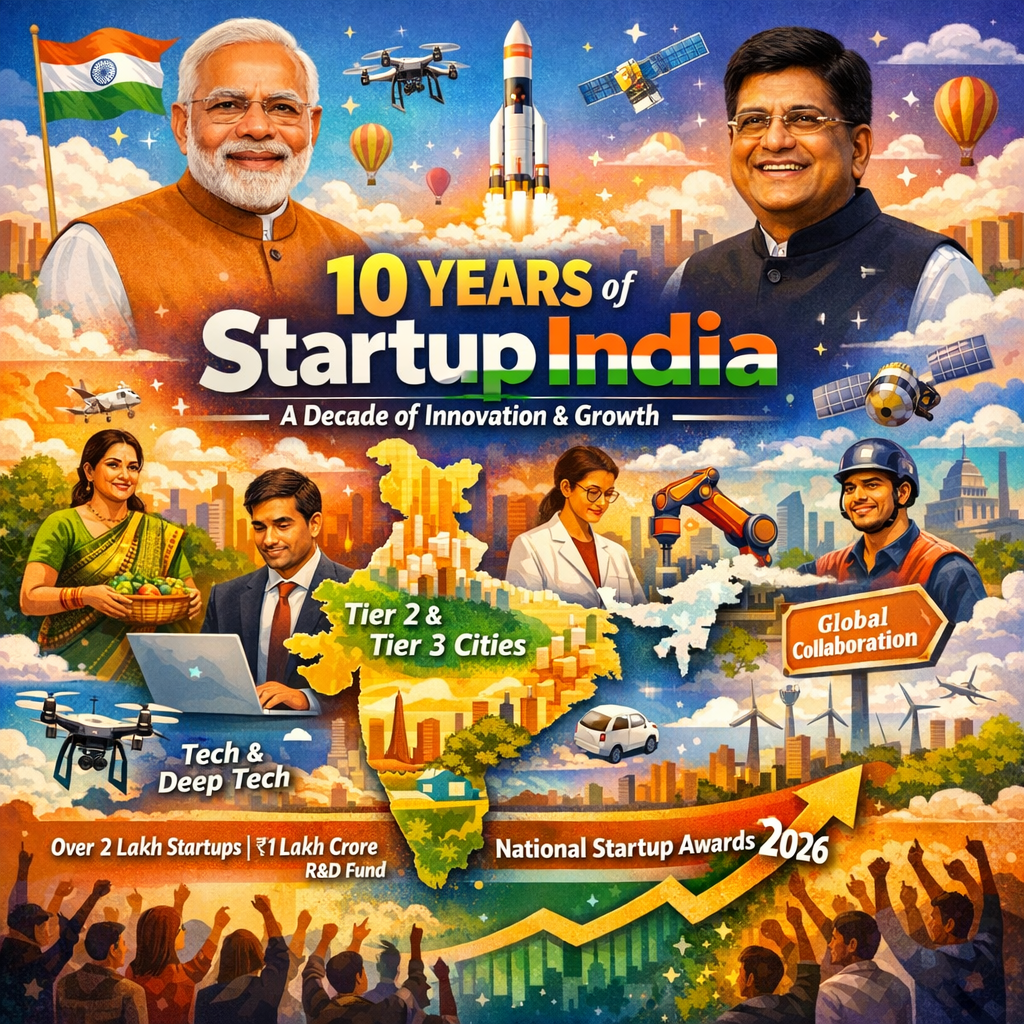
As India marks National Startup Day today, 2026 also closes a defining chapter: ten years of the Startup India initiative. What began in 2016 as a policy push has now grown into one of the most consequential economic movements of New India.
Addressing founders, innovators, and young entrepreneurs at Bharat Mandapam, Prime Minister Narendra Modi described Startup India as far more than a government programme. In his words, it has become a people-led movement shaped by millions of dreams, risk-taking youth, and problem-solvers determined to build from India, for the world.
The numbers tell their own story. India’s startup count has surged from fewer than 500 in 2014 to over two lakh today, making it the world’s third-largest startup ecosystem. Unicorns have risen from just four to nearly 125, with startups increasingly listing on stock exchanges, creating large-scale employment, and drawing sustained global investor interest. Notably, 2025 alone saw close to 44,000 new startups registered, the highest annual addition so far.
Prime Minister Modi said this growth reflects a generational shift. Young Indians are no longer waiting for opportunities but creating them. From agriculture and fintech to mobility, health, sustainability, and space, startups are tackling real-world challenges with confidence and ambition. He added that many of today’s founders will soon become case studies of India’s entrepreneurial success.
Union Minister for Commerce and Industry, Shri Piyush Goyal, traced this transformation back to a clear idea placed before the nation a decade ago: move from job seekers to job creators. When Startup India was launched, India had around 400 startups. Today, over two lakh are registered with DPIIT, generating an estimated 21 lakh jobs across the country.
What stands out, the Minister noted, is how deeply entrepreneurship has entered campuses and communities. Universities now resemble “mini Shark Tanks,” with students actively pitching ideas and building ventures. Interactions at institutions like IIT Madras’ Centre for Innovation, he said, reveal a level of technical depth, creativity, and problem-solving ability that positions India to compete globally.
Startups today operate across more than 50 sectors, including deep tech, artificial intelligence, machine learning, quantum computing, space tech, drones, aerospace, agri-tech, and advanced manufacturing. To back this shift, the government’s ₹10,000 crore Fund of Funds, launched in 2016, has been reinforced with a second tranche of equal size. A significant portion is being directed toward deep-tech and high-impact technologies.
Adding further momentum, the government has announced a ₹1 lakh crore national fund for research, development, and innovation. This is aimed at enabling Indian startups, scientists, and researchers to work at global benchmarks in advanced technologies.
Perhaps the most striking change is geographical. Nearly half of India’s startups now come from Tier II and Tier III cities, underscoring that the startup revolution is no longer metro-centric. From agri-startups in the Northeast and tea-tech collaborations in Assam to Andhra Pradesh’s rise as a drone hub and deep-tech clusters in Karnataka and Tamil Nadu, entrepreneurship is spreading across the map.
Globally, India’s startup story is shaping diplomacy as well. Shri Goyal noted that startup collaboration is now a regular feature in Free Trade Agreement discussions, with close to 100 countries exploring structured startup bridges with India.
The decade-long journey culminated today with DPIIT announcing the results of the fifth National Startup Awards and the fifth States’ Startup Ranking Exercise. These platforms have become key tools for recognising innovation, encouraging accountability, and strengthening state-level ecosystems. This year’s awards expanded to future-oriented categories, with a clear focus on deep tech, Tier II and Tier III startups, and national development priorities.
As Startup India enters its second decade, the focus is shifting from scale alone to depth, resilience, and global leadership. What this really means is that entrepreneurship is no longer on the fringes of India’s growth story. It sits at the centre, shaping jobs, technology, self-reliance, and India’s ambition to emerge as a developed nation by 2047.
Ten years on, Startup India stands as proof that when policy intent meets youthful imagination, an entire economic narrative can change.