









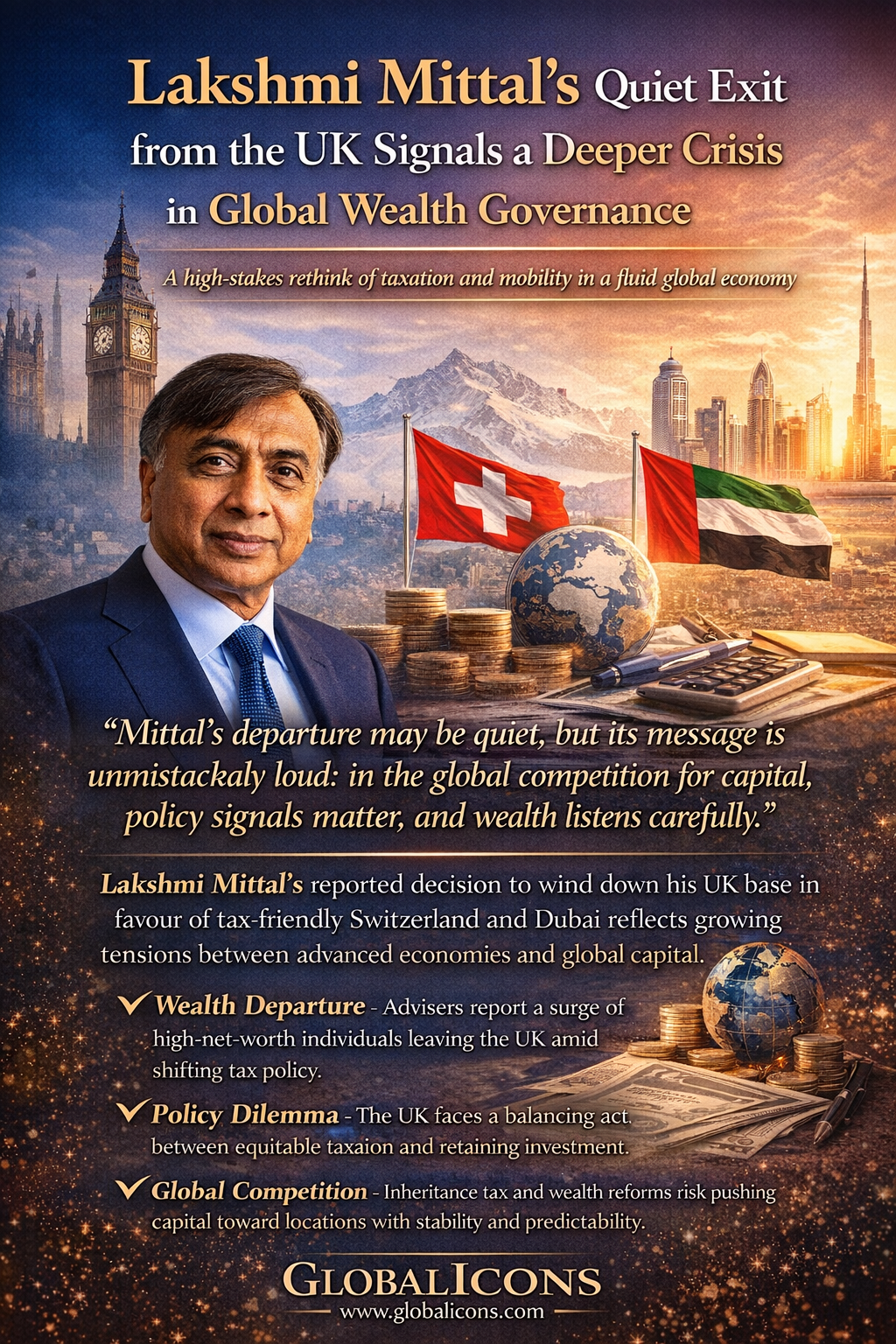
Lakshmi Mittal’s reported decision to wind down his UK base in favour of Switzerland and Dubai is not merely a personal tax planning move. It is a signal event in a larger recalibration underway between governments and global capital. When one of Britain’s most prominent industrial residents begins to disengage, the issue is no longer about one billionaire. It is about the structural consequences of how nations choose to tax mobility.
At the centre of the shift lies the UK government’s decision to abolish the non-domiciled tax regime. For decades, the non-dom framework functioned as a strategic compromise: Britain gained investment, employment, consumption, and philanthropic capital, while globally mobile individuals retained protection for overseas assets. The new approach replaces that equilibrium with a far more expansive tax net, pulling global income, gains, and inheritance into the UK’s fiscal jurisdiction after a defined residency period.
For ultra-high-net-worth individuals, inheritance tax is the real pressure point. The UK’s inheritance tax regime, already among the most aggressive globally, now threatens to extend across worldwide holdings. For industrial families with international businesses, long-term trusts, and assets spanning multiple jurisdictions, this introduces not just higher costs but deep uncertainty. Estate planning relies on predictability, and uncertainty is often the strongest incentive to relocate.
Mittal’s reported preference for Switzerland and Dubai is therefore logical rather than ideological. Switzerland offers negotiated stability, legal clarity, and long-term tax certainty. Dubai offers something even simpler: zero personal income tax, no inheritance tax, and an aggressively pro-capital environment. In a world where wealth is increasingly borderless, such jurisdictions are not exceptions; they are becoming benchmarks.
What makes Mittal’s move particularly consequential is scale. Individuals at this level do not merely pay income tax. They anchor investment ecosystems. Their presence influences where factories expand, where family offices deploy capital, where large-scale philanthropy is institutionalised, and where long-term projects are headquartered. When they leave, the loss is rarely immediate in headline tax figures, but it accumulates quietly across investment flows, charitable funding, and economic gravity.
The UK now faces a policy paradox. In seeking fiscal fairness and broader contribution from the wealthy, it risks undermining the very base that generates sustained, non-linear economic value. Wealth taxes, capital gains revisions, and inheritance expansion may yield short-term political dividends, but they also sharpen the exit calculus for globally mobile capital.
Mittal’s repositioning should be read alongside a growing exodus of high-net-worth individuals from Britain following recent political and budgetary signals. Advisers increasingly describe the mood not as resistance to taxation itself, but to volatility. Wealth can absorb taxation; it struggles with unpredictability.
The deeper question is whether advanced economies can design tax systems that balance social equity with capital retention in an era of unprecedented mobility. If they cannot, the winners will not be the middle classes they seek to protect, but jurisdictions that offer clarity, consistency, and confidence.
Lakshmi Mittal’s departure may be quiet, but its message is unmistakably loud: in the global competition for capital, policy signals matter, and wealth listens carefully.