






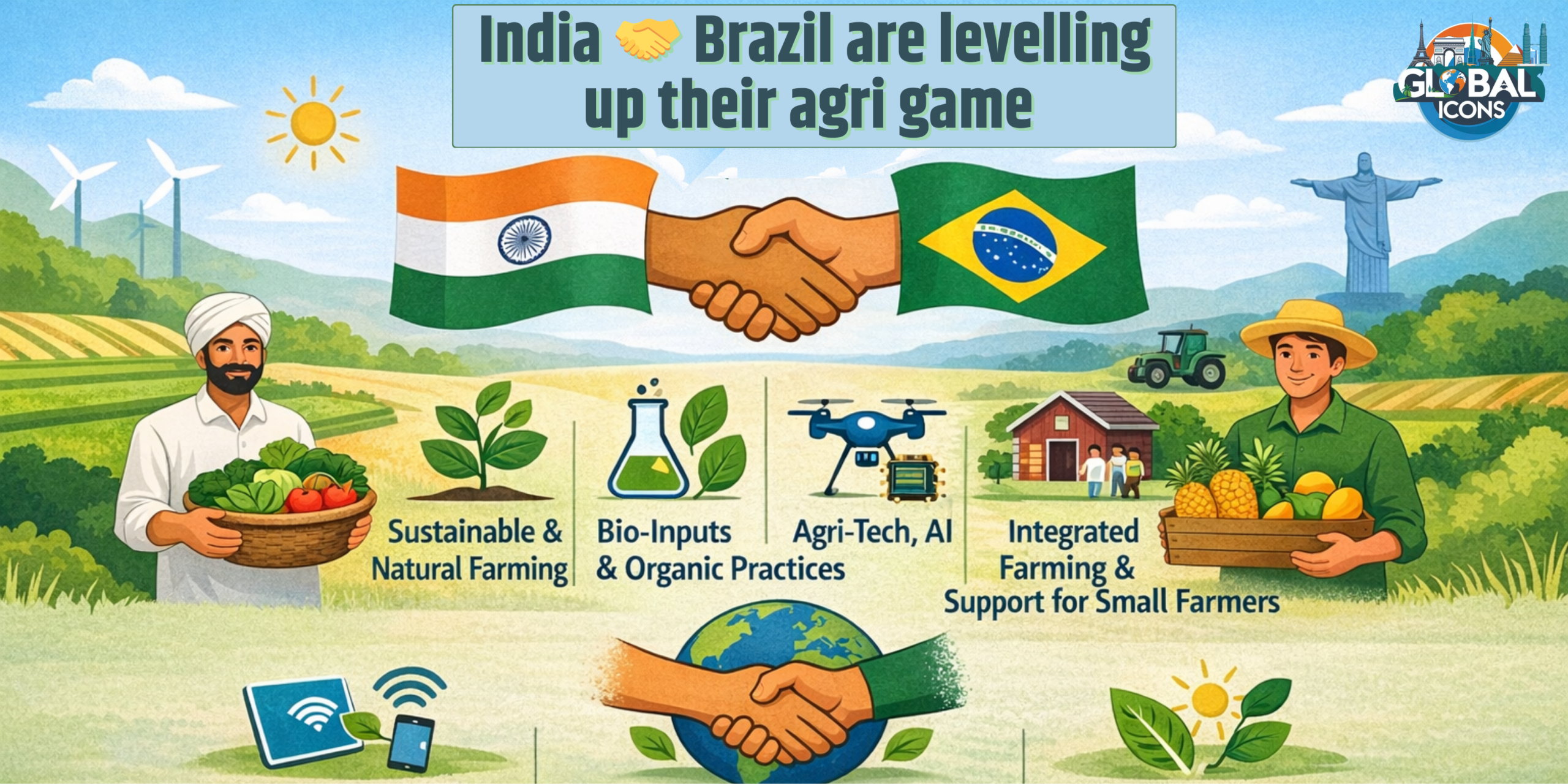
India and Brazil have agreed to significantly scale up cooperation in agriculture and allied sectors, with a sharper focus on bio-inputs, natural farming, agritech innovation and technology partnerships, following high-level ministerial talks in New Delhi. The push comes as both countries position themselves as major food suppliers from the Global South and seek to leverage each other’s strengths to enhance productivity, sustainability and farmer incomes.
High-level talks in New Delhi
Union Agriculture and Farmers Welfare Minister Shivraj Singh Chouhan held bilateral discussions with Brazil’s Minister of Agriculture and Livestock Carlos Fávaro and Minister of Agrarian Development and Family Agriculture Luiz Paulo Teixeira Ferreira at Krishi Bhawan. The ministers reviewed ongoing collaborations, assessed progress in existing projects and identified fresh areas where the two countries could work together in the farm and allied sectors.
Chouhan underlined the “deep-rooted and friendly ties” between India and Brazil, rooted in shared democratic values and reinforced by regular high-level interactions, including recent BRICS engagements. He welcomed Brazil’s participation in the India AI Impact Summit, calling it an important step towards intensifying technological cooperation in agriculture and beyond.
Focus on bio-inputs, natural and integrated farming
A key area of convergence that emerged from the talks is the promotion of bio-inputs and nature-based agricultural practices. Fávaro praised India’s progress in bio-input innovation and pointed to this segment as a promising pillar for future joint initiatives, ranging from research to field-level applications.
Discussions also covered collaboration in natural and organic farming, pulses and oilseeds missions, and integrated farming systems, reflecting Brazil’s growing interest in India’s experience with low-chemical, sustainable cultivation models. Brazilian delegations have recently visited the ICAR–Indian Institute of Farming Systems Research in Modipuram to study India’s nature-based solutions and interact with progressive natural farmers on profitability and product quality.
Centre of Excellence and MoU in the pipeline
Both sides are working towards a dedicated Memorandum of Understanding (MoU) to institutionalise cooperation in agriculture and allied areas, including natural farming, organic practices and integrated systems. As part of this emerging framework, Brazil has agreed in principle to support the establishment of a Centre of Excellence in India to serve as a hub for joint research, training and technology demonstration.
Chouhan said Indian research bodies such as the Indian Council of Agricultural Research (ICAR) will collaborate closely with their Brazilian counterparts under the proposed agreement, with an emphasis on co-developing scalable solutions for farmers in both countries. Officials from Brazil’s agriculture ministries and international relations departments were part of the visiting delegation, underscoring the strategic nature of the initiative.
Innovation, AI and agritech linkages
Agritech and digital innovation have been placed at the centre of the next phase of India–Brazil agricultural engagement. The cooperation is expected to build on initiatives such as ICAR’s “Maitri 2.0” cross-incubation programme, which connects Indian and Brazilian agritech start-ups and research institutions to co-create solutions for productivity, resilience and food security.
Chouhan described Brazil’s participation in the India AI Impact Summit as a signal of intent to deepen collaboration in artificial intelligence and emerging technologies, particularly in areas such as precision agriculture, climate-resilient farming and supply-chain optimisation. Both sides see innovation-driven growth and knowledge exchange as critical tools to modernise smallholder-dominated farm sectors while improving environmental outcomes.
Wider strategic and trade context
The renewed thrust on agriculture dovetails with a broader effort by India and Brazil to elevate their strategic partnership and expand trade. Bilateral trade reached about 15.2 billion US dollars in 2025, and the two countries now aim to push this figure to 20 billion dollars by 2026 and 30 billion dollars by 2030, with agriculture expected to remain a priority component.
Brazilian President Luiz Inácio Lula da Silva’s recent state visit to India and coordination within platforms such as BRICS have also provided fresh political momentum for sectoral cooperation, including in food and nutritional security. Chouhan has invited his Brazilian counterparts to participate in the forthcoming BRICS Agriculture Ministers’ Meeting, signalling an intent to take bilateral agricultural understandings into wider multilateral forums.
Implications for farmers and food security
Officials from both sides stress that deeper cooperation could open up new opportunities for farmers, researchers and agribusinesses in areas such as technology transfer, value addition and sustainable production systems. Joint work on bio-inputs, regenerative agriculture and integrated farming is expected to support more climate-resilient and low-cost models, which are particularly relevant for small and family farmers.
By aligning agriculture, innovation and trade agendas, India and Brazil are seeking to position their partnership as a key driver of food and nutritional security, not only domestically but also across the wider Global South. The agreed roadmap to deepen cooperation in agriculture and allied sectors is likely to translate into a mix of policy dialogue, joint projects and institution-to-institution linkages in the coming years.