








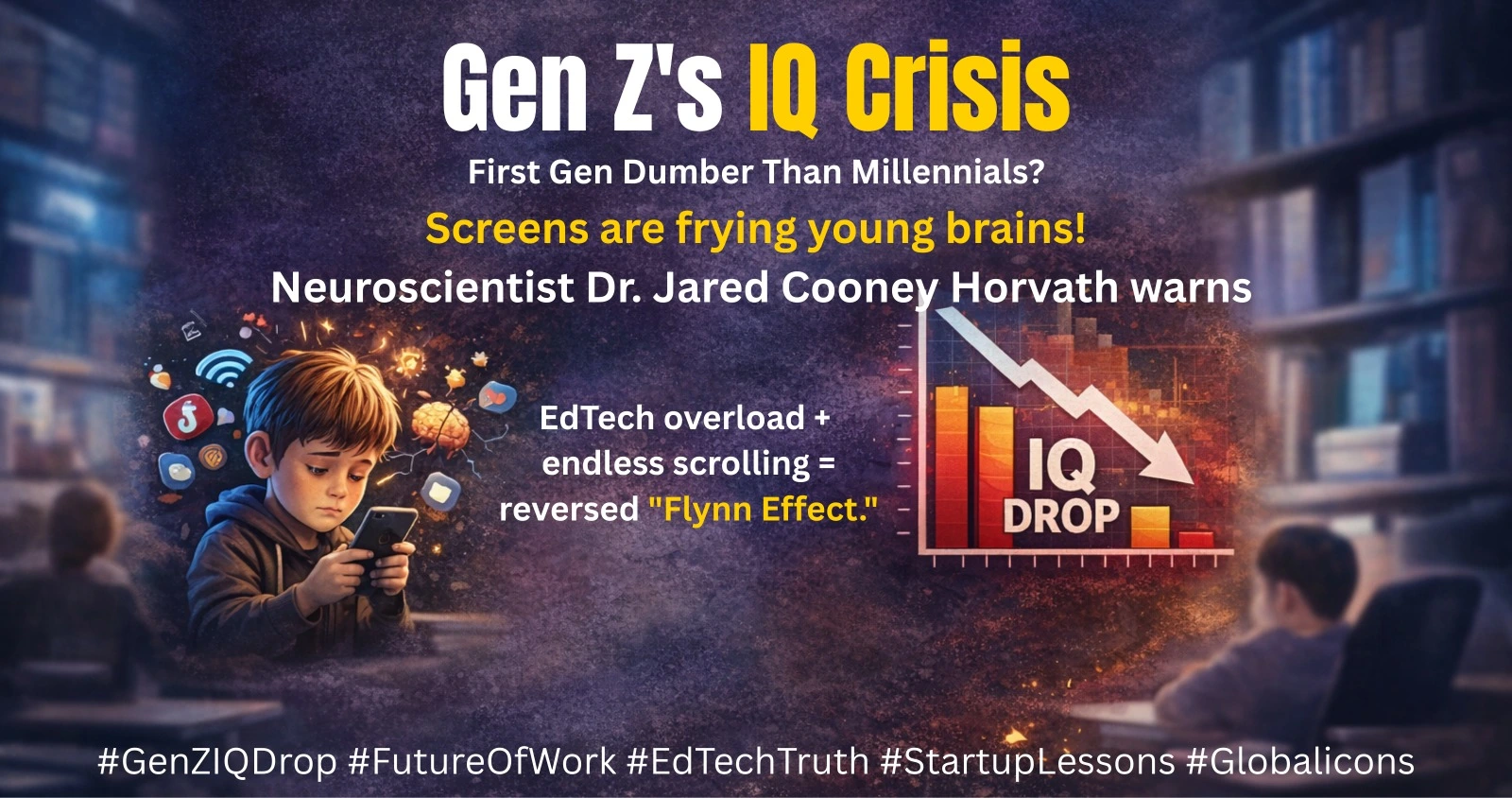
Recent studies show Gen Z (born 1997-2012) is the first generation in 150 years with lower IQ scores than millennials. This reverses the “Flynn Effect,” where IQ rose each generation due to better nutrition, education, and health.
Neuroscientist Dr. Jared Cooney Horvath told the US Senate in January 2026 that Gen Z lags in attention, memory, reading, math, problem-solving, and overall smarts—despite more school time. He links it to EdTech: screens dominate class, with kids wasting up to 38 minutes per hour off-task.
Why Screens Hurt Brains
Teens spend half their waking hours on devices, swapping deep learning for quick scrolls. Humans learn best face-to-face or through focused study, not bullet points—biology hasn’t caught up to tech. Global data from 80+ countries shows: more classroom screens, worse scores on tests like PISA.
What It Means for Leaders and Startups
For entrepreneurs building edtech or workforce tools, this is a wake-up call—Gen Z may struggle with focus and reasoning needed for innovation. Leaders: rethink hybrid learning, cut screen overload, boost real talks and deep work to rebuild skills. Future success depends on smarter fixes now.